
Civilization At A Crossroads

Standing at the Acropolis, where, as long as 5,000 years ago, the same humans who would go on to create democracy, modern philosophy, drama, theater, and the university tradition once stood, was as inspiring as anything in my life. It reminded me why studying history, practicing philosophy, and utilizing critical thinking are so important, especially in the modern age.
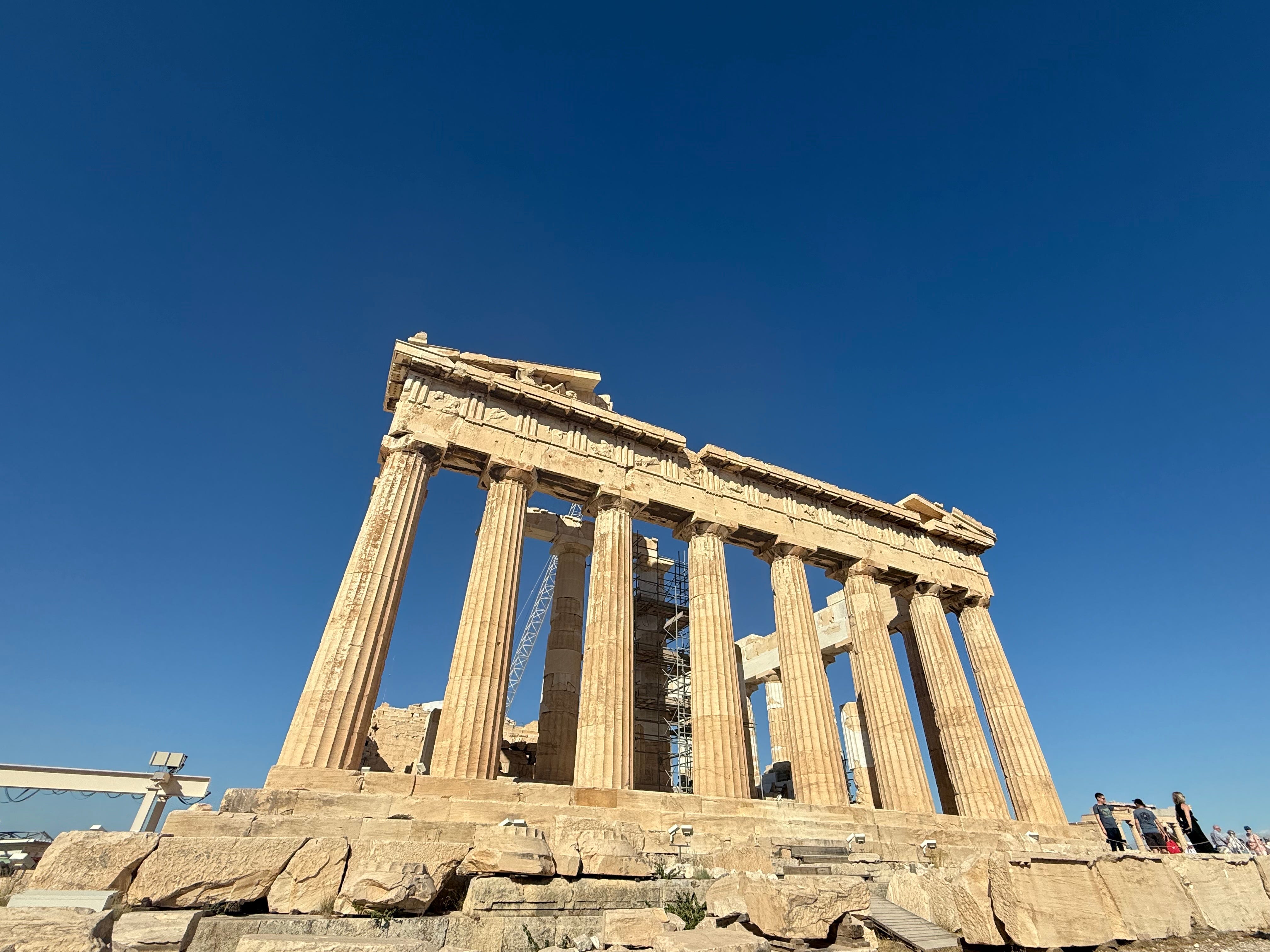
It was also somewhat depressing, in the sense that comparing the value sets of the ancient Athenians to modern-day Western civilization, especially in America, feels sobering. Hundreds of thousands of people travel to the ruins every year to witness buildings and structures made thousands of years ago. Why? First, they were made to last, using marble and bronze, built with an eye toward the future and with materials that could stand the test of time.
Compare that to this day and age, where we use materials that ensure the highest profit margins but break down in a couple of decades. Just look at our infrastructure in the U.S.—we put profit over longevity. It’s hard to imagine anything we have made as a culture lasting as long as something like the Parthenon.
Second is the attention to detail and beauty. The structures that remain are still some of the most beautiful, symmetrical, and detail-oriented in the world. Why? Was there some economic benefit? No. It’s because the Athenians believed in virtue, not only of oneself, but in their craftsmanship. They believed what they made was an extension of themselves, of the human soul. So if they were to have virtue, so must what they built.
Imagine that in the modern age, companies, CEOs, governments, and leaders who put virtue over profits; who understand that everything they do is an extension of their value set (or lack thereof).
As I stood there, a belief I already held was solidified: the commodification of human existence has left us largely devoid of values, ethics, and virtue. Very few people, let alone our elected officials or CEOs, do things for the pure virtuosity of them. Almost all decisions made these days seem to be about how much profit can I extract from this next decision or action?
In the long run, this has led us to where we are today: leaders who put foreign wars or agendas over the needs of their own citizens; leaders who put the wants and needs of their wealthiest donors and friends ahead of what’s best for the masses. We have CEOs and corporations that make decisions only about increasing shareholder value. In turn, products and services are devoid of meaning. And when hard decisions need to be made, without morals or ethics to stand on, the guiding light becomes what will make the most money. Society then takes the brunt of this, as much of our world is shaped by the wealthy billionaire CEO class.
Is this to say ancient civilizations were perfect? Of course not. Greece, Rome, Egypt etc. each had issues, many of the same we have today: exploitation, haves and have-nots, lying, cheating, and more. But I argue that, at least in Athens for a time, there was a society that, on the whole, sought virtue, beauty, and knowledge. How else could it produce the beauty of the Acropolis or thinkers like Socrates and Plato?
Today, we have a society en masse that is more oriented toward wealth extraction than toward the production of beauty and quality. We focus more on self-aggrandizing than on communal or societal improvement. We chase cheap dopamine highs over chasing knowledge and self-discipline.
So, is all hope lost? I don’t know.
All I know is that all we can do is focus on improving ourselves, living and acting with virtue, practicing philosophy, spending time reading, writing, and sitting in silence. All any of us can do is take control of ourselves, our own ruling government, our inner republic. Take control of that, and maybe—just maybe—if enough follow suit, things can shift.
Until then, I’ll work to control myself and aspire to the ideals set out by Socrates, Seneca, Epictetus, and Marcus Aurelius, to strive for something more than just money, status, or power.